Calculation screen
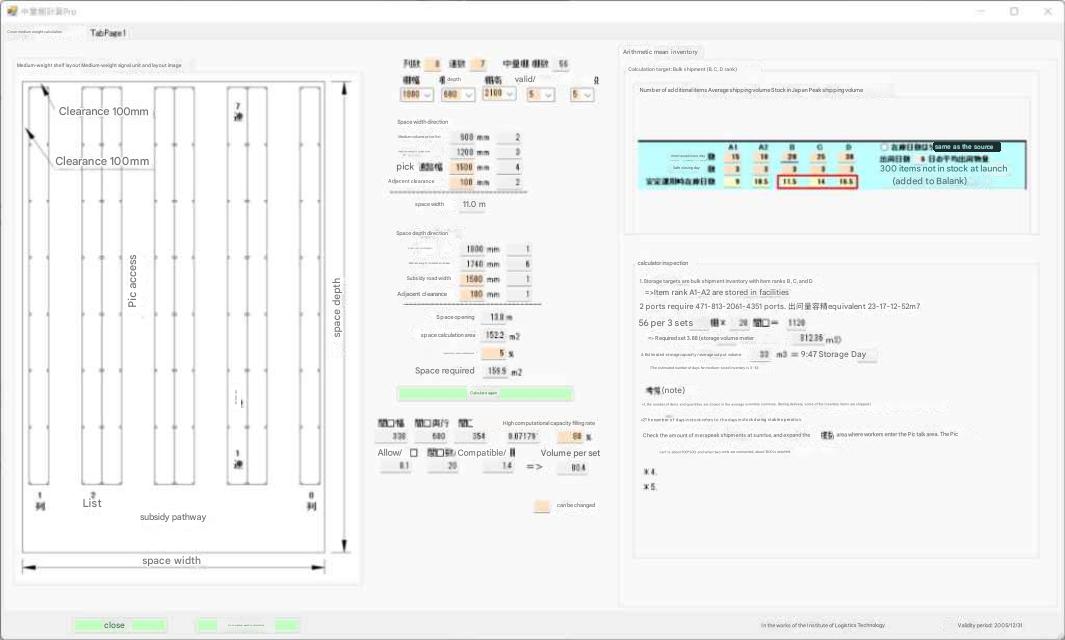 |
After setting the specifications of the medium-duty shelves and the number of rows and rows, the installation area is calculated.
|
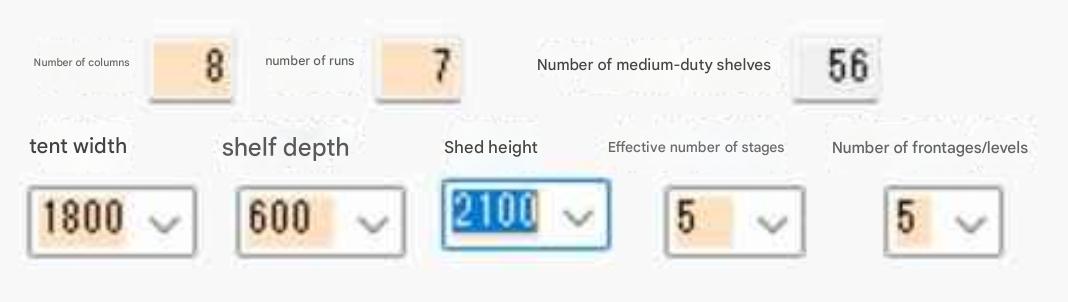
| shelf frontage |
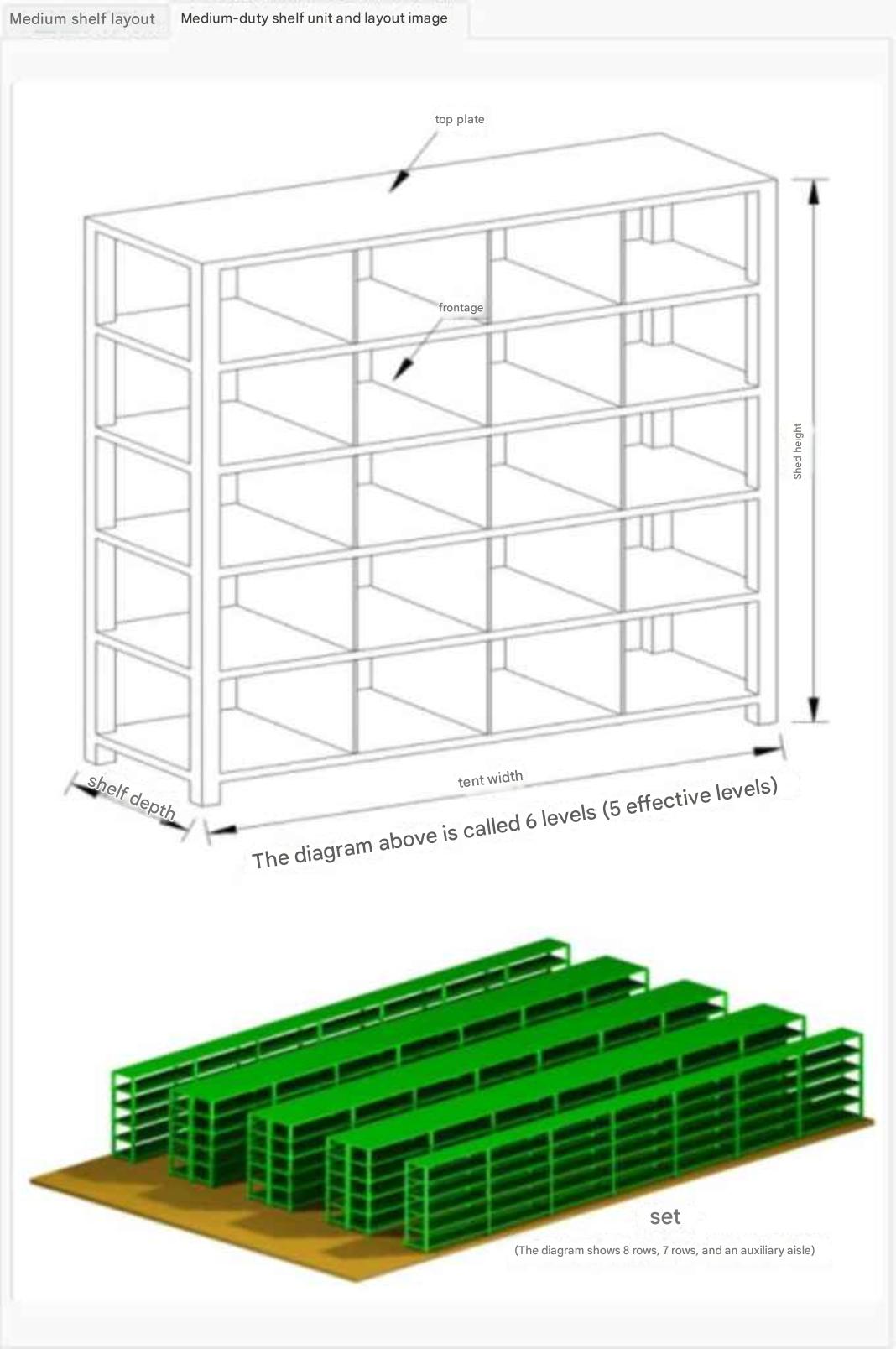 |
The number of items stored on a medium-duty shelf determines the number of items stored per shelf. Since the openings do not need to be evenly spaced, combining small-volume items with large-volume items increases shelf fill rates. Items are stored in two locations: the inventory storage area and the shipping space area with medium-duty shelves. For 1,000 target items, the center inventory days = 40 days, the center inventory volume = 100 m3, the effective shelf storage volume of the medium-duty shelves = 50 m3, and the shelf fill rate = 70%, the effective shelf storage volume of the medium-duty shelves = 35 m3. The -duty shelf inventory days = (35 m3 / 100 m3) * 40 days = 14 days , which is 26 days for the inventory storage area and 14 days for the shipping area. Considering the workload of replenishing items from the inventory area to the shipping area, the shipping area (medium-duty shelves) should ideally have at least 20 days of inventory. So, when calculating the above, what is the composition of the inventory items in the inventory storage area and shipping area? The number of items in the work area is 1,000 items, and the number of items in the inventory storage area is 790 items.Inventory storage area : Number of items reduced = (medium-weight shelf inventory days / center inventory days) * number of items * 0.6 Number of items reduced = (14/20) * 1,000 * 0.6 = 210The above calculation is an example based on experience.PL fixed shelves and automated warehouses have a height of 3,000 mm, so the adjacent clearance is 200 mm, but the height of flow shelves and medium-weight shelves is less than 3,000 mm, so an adjacent clearance of 100 mm is sufficient. |
| The total inventory at the center is obtained from the table below |
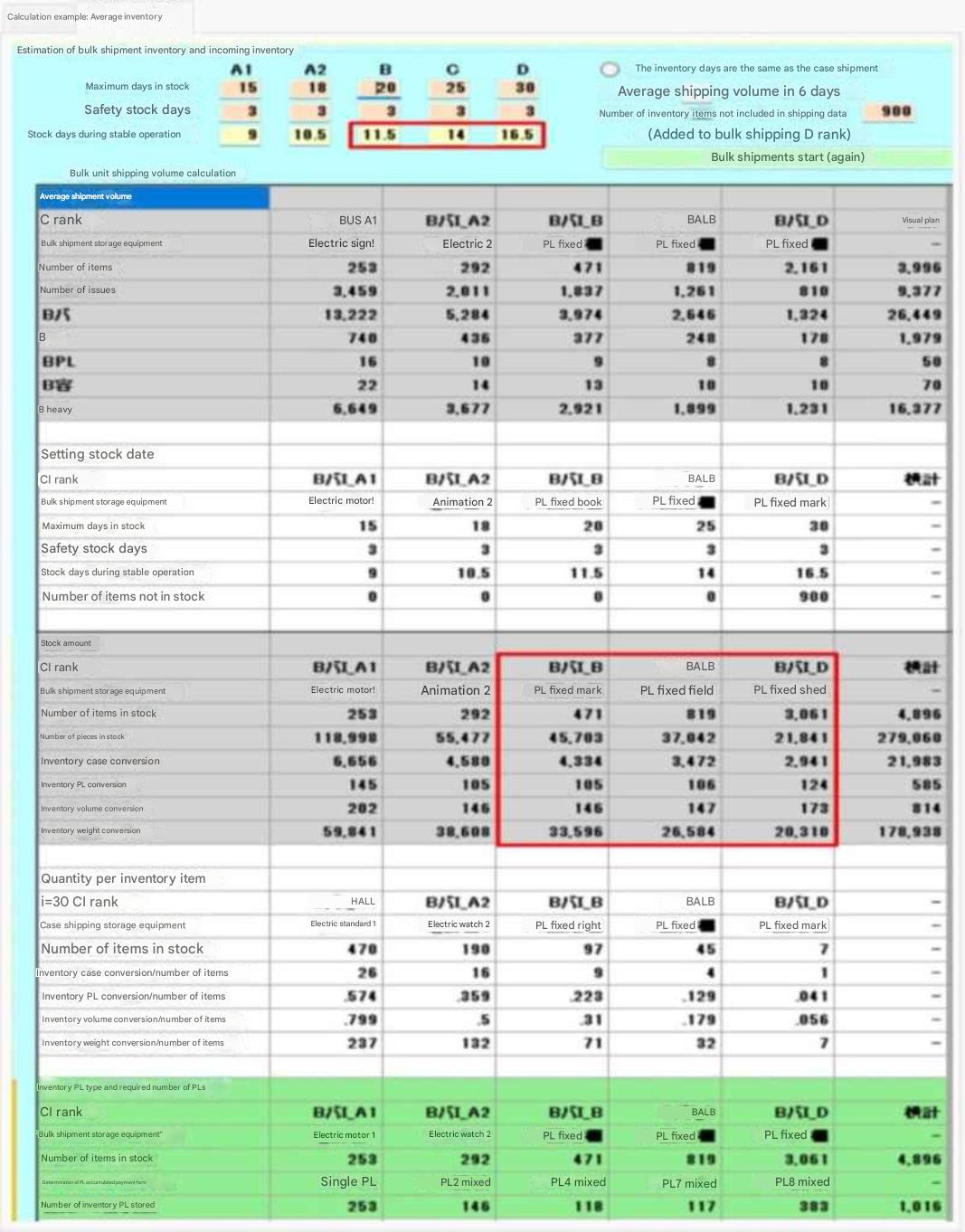 |
The table on the left is obtained by inventory quantity estimation calculation. Items on the medium-volume shelves are BBaI_B, BBaI_C, and BBaI_D. For how to read the table, see Inventory quantity estimation calculation. |