Section 5: Receiving Space


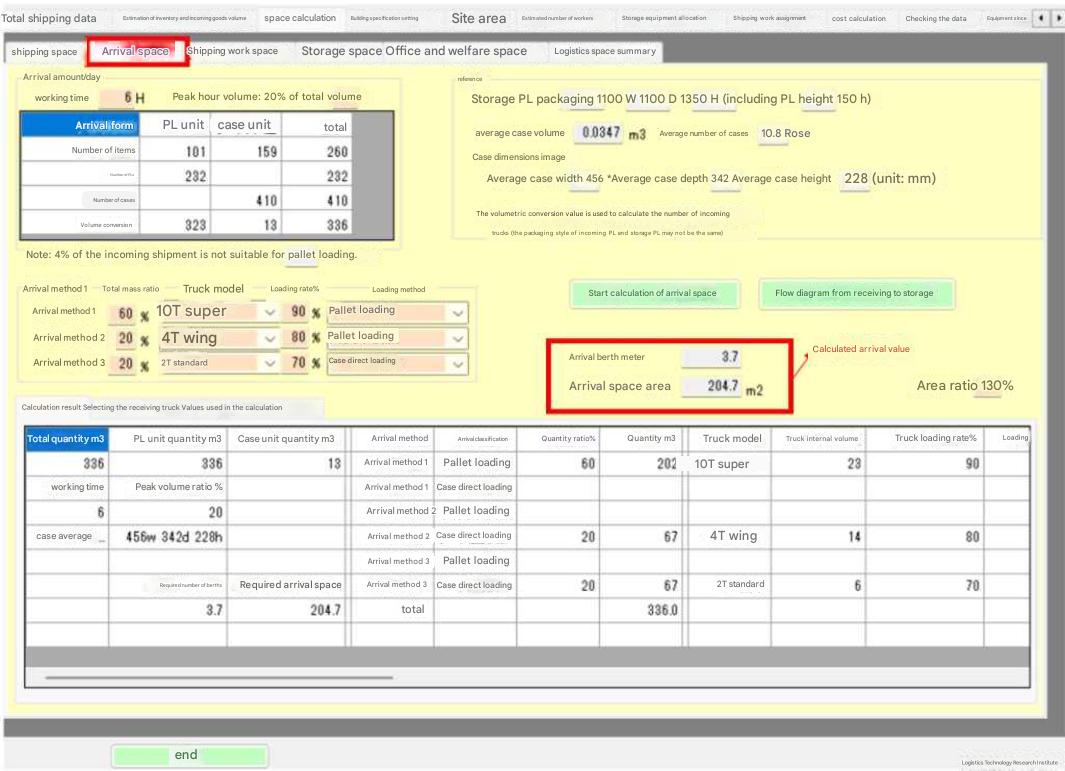
Receiving space calculation screen


Item 1. Calculation of receiving space area and number of berths

Regarding shipping, the distribution center cannot arbitrarily increase or decrease the ordered shipping quantity or change the delivery date and time. On the other hand, regarding receiving, the quantity and arrival date and time can be specified when placing the purchase order. By controlling receiving, the distribution center can avoid busy times and busy days of the week when performing receiving work.

Incoming goods are received from the shipping space during non-shipping times.
By sharing this shipping space, the amount of receiving space can be reduced.
Although there are few examples, there are also distribution centers where a receiving agent (an employee of another company) carries out the receiving work, transports goods to the storage shelves, and replenishes the bulk picking shelves in the middle of the night when there are no shipments. Such distribution centers use the shipping berth and shipping space for receiving goods, so there is no need for a receiving berth and receiving space.

Just because the volume of incoming goods is large does not necessarily mean that the number of berths or receiving space will be large.
Tera 
Calculation 2 calculates the number of berths and receiving space from the volume of incoming goods, and then allows you to input the new amount of receiving space and shipping space that can be shared, allowing you to recalculate the receiving berths and receiving space. Depending

on the incoming goods, such as imported goods, it can be difficult to manage the arrival date and time, and the arrival date may differ. In such cases, measures such as evacuation waiting space outside the premises will be necessary.

Below, we will explain how to calculate receiving space and the meaning of the terms.

Section 2. Arrivals Peak hour volume

Peak hour volume is the volume of goods during the busiest hour of the day ( 1 hour),
incoming volume is the volume of goods received calculated on the estimated incoming volume screen, and ratio is 
the percentage that indicates what percentage of the peak hour volume corresponds to when the estimated incoming volume is 100 %. Ratio = (peak hour volume / daily incoming volume) * 100 .


Section 3 : Receiving Method

Tera Calculation 2 offers three patterns for when ordered goods arrive at the distribution center. You can
set the type of vehicle, loading method, and loading rate to be used at peak arrival times.


Item 4: Quantity Ratio

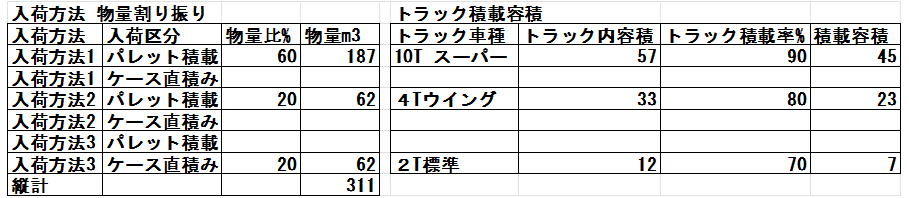
The percentage of the quantity allocated to receiving methods 1-3. Calculated as follows: Quantity of receiving method 1 = (Total quantity of goods received by receiving method 1 / quantity of goods received) * 100 .

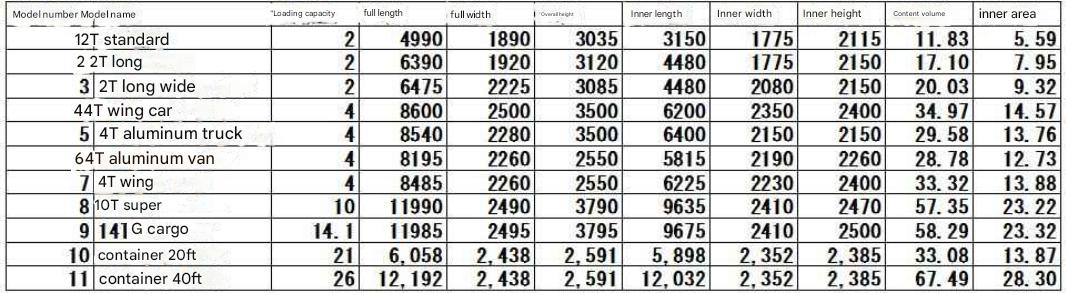
Item 5. Vehicle Types of Trucks Delivered

The loading capacity of the loading platform varies depending on the type of truck. To set the loading capacity, select one type of vehicle to be calculated. Keep in mind that the turning radius will vary depending on the type of vehicle selected, which will affect the site layout. Larger vehicles are used for receiving goods than for shipping, as the quantity per item is larger. Also, there are vehicles that deliver to multiple distribution centers (without unloading all of their load).
Containers are used for long-distance transportation, and 40ft containers in particular are often used for imports.
I'll write the text here.

Section 6: Incoming trucks and loading rates


Normally, the loading rate of a truck is equal to the volume of the cargo divided by the internal volume of the truck, but the loading rate at the time of arrival is equal to the loading rate of the receiving truck = the volume of the unloaded cargo divided by the internal volume of the truck . For example, if a 2-ton long truck arrives with a loading rate of 90 % and unloads 20% of the cargo, the loading rate of the receiving truck is considered to be 20 %.


Item 7. Truck Loading Methods

There are two types of loading methods: pallet loading and direct case loading. Pallet loading is ideal as it allows for quick loading and unloading from trucks, but for vehicles with a load capacity of less than 4 tons, the loading rate of pallet loading is low, so direct case loading is common. Pallet loading is used on large trucks that can load two pallets per bed width, but there is a loss of two pallet thicknesses (150 mm x 2) relative to the height of the truck bed.
Large trucks for long-distance transport often use direct case loading to avoid this loss in pallet thickness.
Direct case loading is calculated using the case volume. Pallet loading is calculated using the direct case loading calculation * ((number of loaded pallets * 150) / truck bed height).

Section 8. Incorporation of Air Transportation Equipment into Calculations

When loading on pallets, the receiving berth area is the shipping waiting area + the temporary storage area of ​​returned empty pallets. When loading directly onto cases, the calculation is based on the temporary storage area of ​​returned empty pallets = 0.

Item 9. Number of Arrival Berths

An inbound berth is the opening (also called a dock) of a distribution center where inbound trucks need to unload their cargo, and the number of inbound berths is the number of docks required during peak hours ( 1 hour). Calculated by dividing the cumulative truck arrival time ( minutes ) per hour by 60 minutes. Truck arrival time is preset for each vehicle type. (See Inbound Space Calculation.xlsx )

Section 10: Receiving Space Area Ratio

The calculation of the receiving space area does not take into account gaps between waiting products, aisles for workers to load and unload, work and office space, etc. The calculation of the number of receiving berths does not take into account inspection time, time to process slips, delays caused by interference between receiving and shipping trucks, etc.
These required times are taken into account using the area multiplier.

Chapter 4 Tera Calculation 2_Distribution Center Size Calculation
1