Item 2: Estimated Inventory Quantity


The method for calculating inventory quantity from shipping data was described in the previous section. As
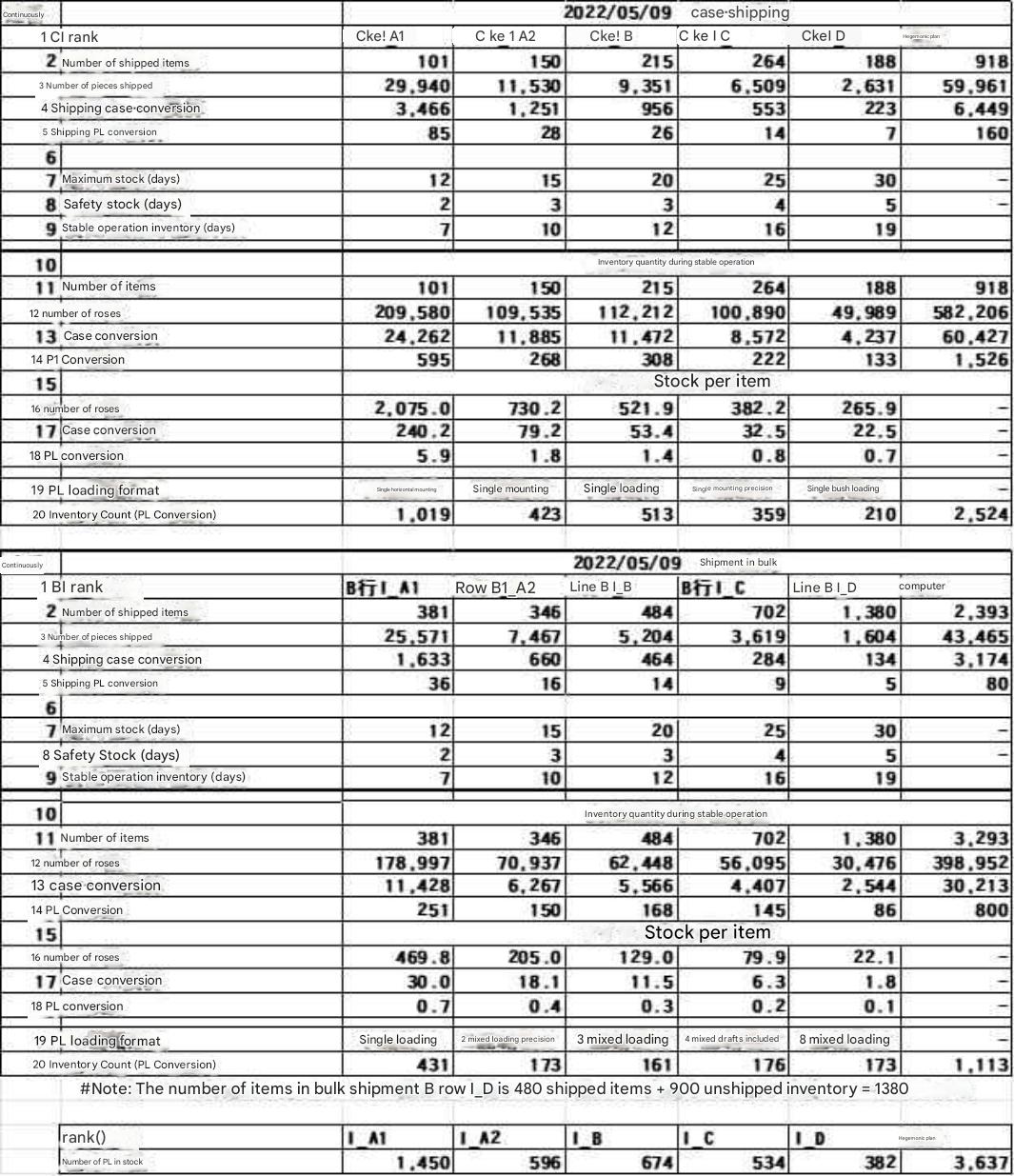
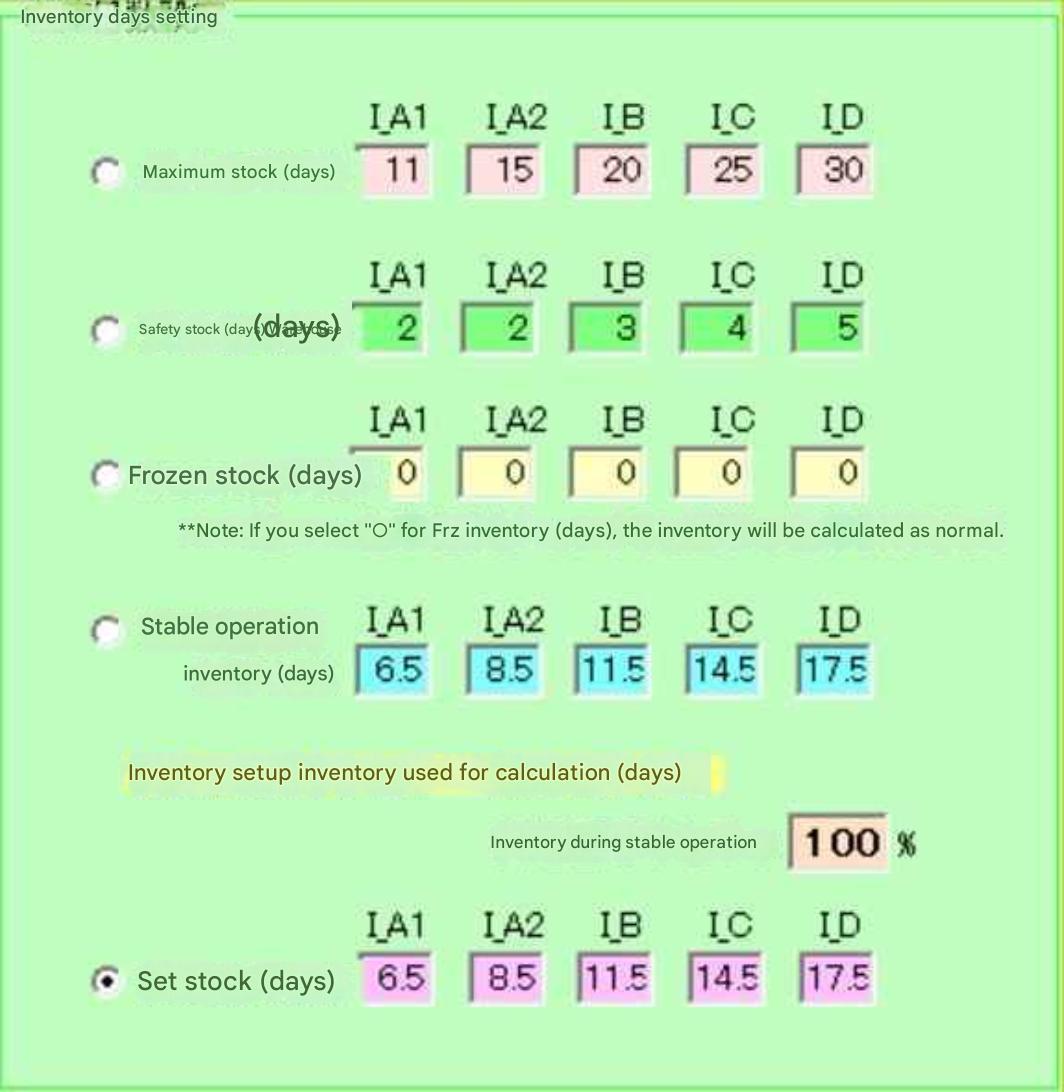
an example, we will explain the procedure for calculating inventory quantity ( PL equivalent) from shipping data 2022/05/09 . 1. Calculate the shipping quantity for 2022/05/09 by item rank (sequential numbers 1-5 ). 2. Specify the maximum inventory quantity (days) and safety stock (days) (sequential numbers 7-8 ) and calculate the stable operation inventory (days). The formula is stable operation inventory = (maximum inventory ( days ) - safety stock ( days ) ) / 2 + safety stock ( days ) (sequential number 9 ). 3. Calculate the stable operation inventory quantity. The formula is shipping volume * stable operation inventory (days). 4. Calculate stable operation inventory * shipping volume (sequential numbers 10-14 ). For serial numbers 16-18 , calculate stable operation inventory / number of items. 5. The key to this spreadsheet is calculating the pallet loading method. Single loads are 1 item loaded on a pallet, 2-item mixed loads are 2 items loaded on a pallet, and in mixed loads the first number indicates the number of items loaded on the pallet. The method for distinguishing single loads and mixed loads is that if the inventory per item ( PL conversion) is 0.5PL or more it is a single load, 0.5PL to 0.33 is a 2- item mixed load, 0.32 to 0.25 is a 3- item mixed load , 0.24-0.125 is a 4- item mixed load, and 0.125 or less is an 8- item mixed load. The PL conversion for mixed loads is calculated as the number of items / number of items loaded in the PL .

Tera calculations add the number of unshipped items to the number of shipped items in row B, rank I_D for bulk shipments. Also, when calculating storage space, the amount is calculated as 1.1 times the amount calculated above ( Tera settings). Note: This calculation is a simple aggregation of the PL conversion of shipping data. The number of loads per PL must be taken into consideration.
Section 1: Difference between average inventory and stable operating inventory


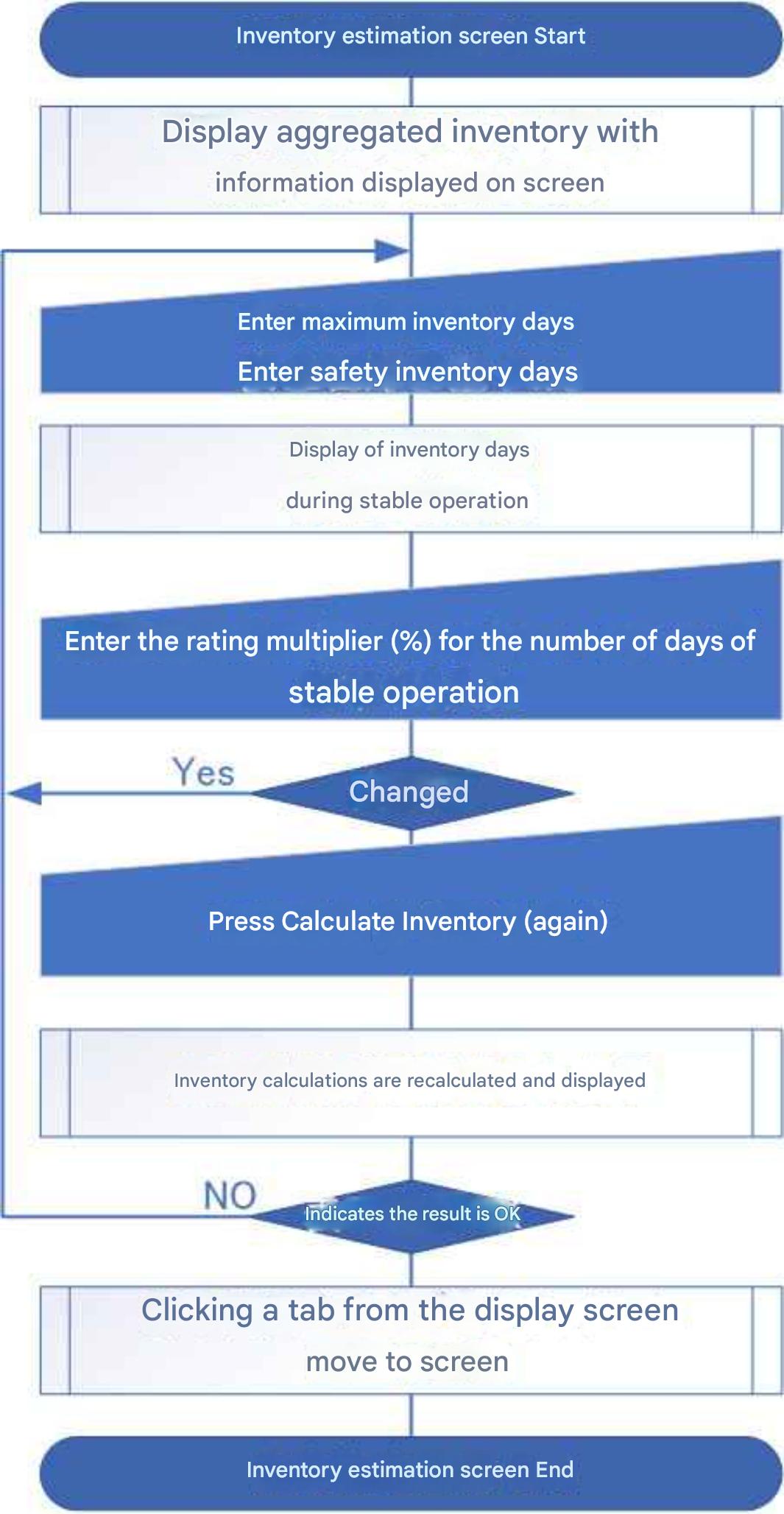
The left figure shows the flow of the inventory estimation screen for tera calculation 2.

Inventory refers to the quantity of goods received and stored in advance for shipment.
Inventory quantity can also be expressed in units of inventory days, which means the quantity equivalent to the number of days of shipment. In Tera calculations, inventory (days) refers to inventory days.
Maximum inventory is the upper limit of inventory; no more inventory is held. Safety stock is the lower limit of inventory, always maintained. In the event of a delay in arrival or unexpected shipments, this safety stock is used for shipping. The maximum inventory minus the safety stock is the fluctuating inventory, and daily inventory fluctuations fluctuate within this range. The order point is the inventory on the order date, calculated backward from the time of purchase order placement to arrival. The inventory at this order point is called the minimum inventory. Purchasing staff place purchase orders when inventory decreases to the minimum. To maintain maximum inventory days and reduce storage size, the arrival dates of each item are staggered (for example, if there are 180 items with a fluctuating inventory of days , 30 items will arrive per day). By managing steady-state inventory = fluctuating inventory /2 + safety stock, the inventory level of the entire distribution center can be kept at a minimum and constant. In Tera calculations, this managed inventory is called steady-state inventory.

Let's explain with an example calculation. In the diagram below , if the shipping quantity is 10 units per day, then "Maximum inventory = number of shipments * maximum inventory period = 10 * 8 = 80 units", "Average inventory = maximum inventory / 2 = 40 units", "Safety inventory = number of shipments * safety inventory period = 10 * 2 = 20 units", and if the arrival period is 2 days, then "Minimum inventory = safety inventory + (shipment quantity * arrival period) = 20 + ( 10 * 2) = 40 units".

Tera Calculation's inventory calculations do not use average inventory, but instead use the following calculation for stable operation inventory:
"Variable inventory = shipment quantity * (maximum inventory period - safety inventory period) = 10 * (8 - 2) = 60 units."
"Stable operation inventory = (variable inventory / 2) + safety inventory = 30 + 20 = 50 units." Based on the above calculations, if purchase orders are placed repeatedly at minimum inventory levels, maximum inventory = minimum inventory. If purchase orders are placed daily starting three days before shipment, maximum inventory equals "safety inventory + shipment quantity * 1 day." Some distribution centers, such as those selling milk with a short shelf life, do not have safety inventory and simply ship the same day they receive it. However, most distribution centers have inventory (maximum inventory) that is more than twice the minimum inventory. Maximum inventory is set taking into account company-wide benefits, such as differences in purchase unit prices depending on the quantity purchased, product availability, and, for manufacturers, securing production lots. Tera calculations are designed to allow maximum inventory and easy-to-deliver inventory to be changed at will, since setting the inventory amount that can guarantee shipping volume solely for the convenience of the distribution center results in a low inventory setting that does not match the current situation.

Note: "Stable operation inventory" is a term used to explain Tera calculations and is not an inventory term. Also, the meaning of "average inventory" is different from the inventory term "average inventory." Please refer to other books for information on average inventory.

Some people say that it is pointless to use Tera Calc to calculate inventory and receipt data when we already have actual inventory and receipt data on hand .
However, the author believes that inventory and receipt data should not be used as is. Based on

the Tera Calculation philosophy of " inventory for shipment and receipt for securing inventory," the question remains as to whether the actual data (inventory data and receipt data) are appropriate when viewed from the perspective of shipping data. We believe that verifying the differences between
calculated shipping data (inventory amount and receipt amount) and actual data ( inventory amount and receipt amount) will provide a new perspective for designing and improving logistics systems.

Tera 
Calculation calculates inventory and receipt amounts from shipping data.

The author believes that it is necessary to explain to data providers "where inventory data and incoming data are positioned relative to shipping data" and to calculate incoming and outgoing quantities based on a common understanding with the data provider.
If this task is neglected, potential problems may be overlooked and the system may be designed with incorrect settings.

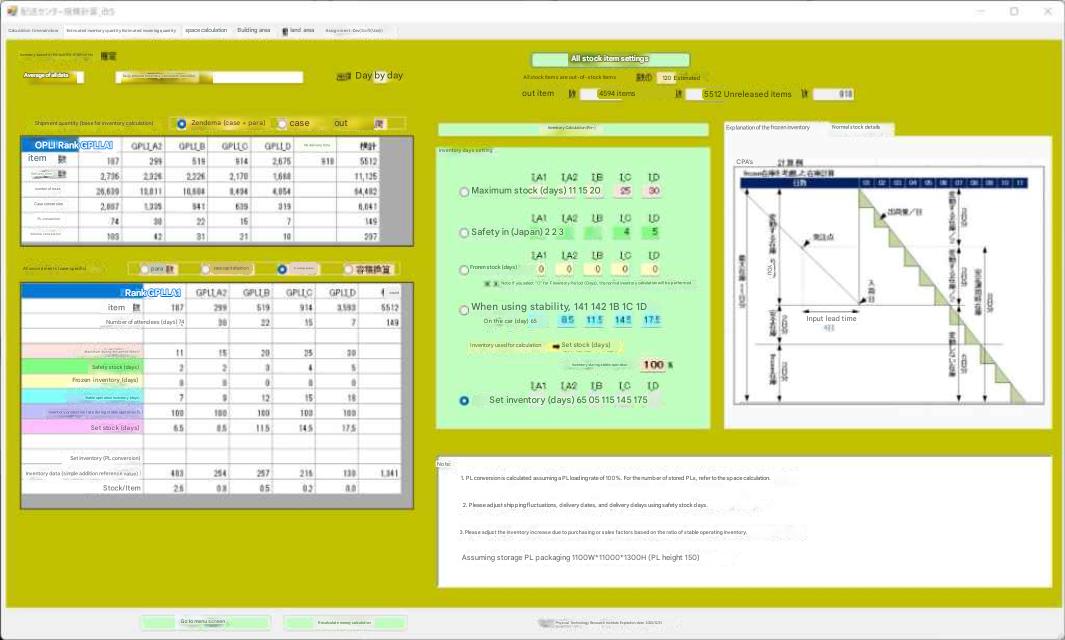
Inventory quantity estimation screen

Section 3 Estimation of Inventory Amount

Chapter 4 Tera Calculation 2_Distribution Center Size Calculation