第2項
在庫量推定
出荷データから在庫量を計算する方法は前項で述べた。
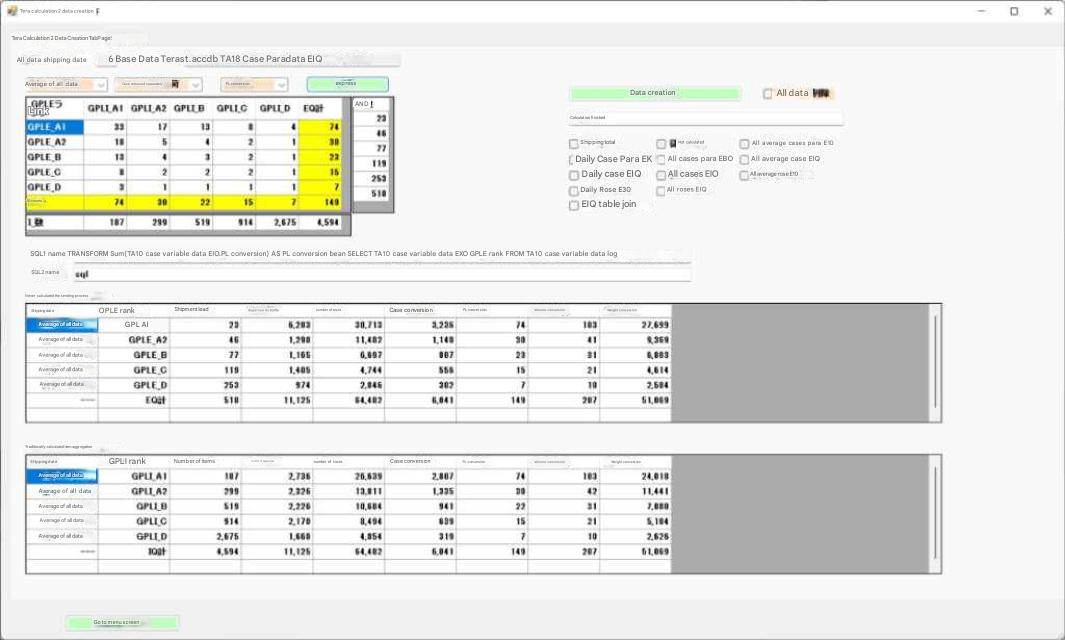
計算例として、出荷データ2022/05/09から在庫量(PL換算)計算する手順を説明する。
1.アイテムランク別に2022/05/09の出荷物量算出(連番1-5)。
2.最大在庫数(日)及び安全在庫(日)で指定し(連番7-8)、安定運用時在庫(日)を計算、計算式は安定運用時在庫=(最大在庫(日)―安全在庫(日))/2+安全在庫(日)である(連番9)。
3.安定運用時在庫数量を計
![]() |
写真説明 |
算、計算式は出荷量*安定運用時在庫(日)。
4.安定運用時在庫*出荷量で計算(連番10-14
)。連番16-18は安定運用時在庫/アイテム数で算出。
5.この表計算のポイントは、パレット積付方法の計算。 単載積付はパレットに1アイテム積載、2混載積付はパレットに2 アイテムを積載で、混載積付は先頭数字がパレットに積載するアイテム数を示している。
単載積付と混載積付を区分する方法は、アイテム当たり在庫(PL換算)が0.5PL以上で有れば単載積付で、0.5PL~0.33は2混載積載、0.32~0.25は3混載積載0.24-0.125は4混載積載で、0.125以下は8混載積載として計算している。
混載積載のPL換算はアイテム数/PL積載アイテム数で算出する。
![]() |
写真説明 |
Tera計算では、バラ出荷のB行I_Dランクの出荷アイテム数に出荷していないアイテム数を加算している。 また、保管スペース計算時は上記計算の1.1倍(Tera設定)物量として計算している。
Second-term inventory estimation
The method for calculating inventory quantity from shipping data was explained in the previous section. As
a calculation example, the procedure for calculating inventory quantity ( PL conversion) from shipping data 2022/05/09 will be explained. 1. Calculate shipping quantity for 2022/05/09 by item rank (serial numbers 1-5 ). 2. Specify maximum inventory quantity ( days) and safety stock (days) (serial numbers 7-8 ) and calculate stable operation inventory (days). The formula is stable operation inventory = (maximum inventory ( days ) - safety stock ( days ) ) / 2 + safety stock ( days ) (serial number 9 ). 3. Calculate stable operation inventory quantity .
![]() |
Photo description |
The formula is shipment volume * inventory during stable operation (days).
4. Calculate inventory during stable operation * shipment volume (sequential numbers 10-14 ). Serial numbers 16-18 are calculated as inventory during stable operation / number of items.
5. The key to this spreadsheet is calculating the pallet loading method. Single loading is loading one item onto a pallet, 2-item mixed loading is loading two items onto a pallet, and for mixed loading, the first number indicates the number of items loaded onto the pallet.
To distinguish between single and mixed loading, if the inventory per item ( PL conversion) is 0.5 PL or more, it is single loading; 0.5PL to 0.33 is 2- item mixed loading; 0.32 to 0.25 is 3- item mixed loading ; 0.24-0.125 is 4- item mixed loading; and 0.125 or less is 8- item mixed loading. The PL conversion for mixed loads is calculated by dividing the number of items by the number of items in the PL load.
![]() |
Photo description |
In Tera calculations, the number of unshipped items is added to the number of shipped items in row B, rank I_D for bulk shipments. Also, when calculating storage space, the amount is calculated as 1.1 times the amount calculated above ( Tera setting).